
A CHRISTMAS EVE ENCOUNTER

Many years ago when I was a reporter, I received a letter from a man that contained his account of a very strange Christmas Eve experience. He wished to remain anonymous and hoped, if his letter was published, the inside addressee would get to read it. It went like this:

“Dear Santa: I’m sorry I haven’t written to you in 60 years. You might remember in my last letter I asked for a pony and you brought me a hobby horse instead. I forgave you for that many years ago.

I’m writing now about the very big favor you did for me when we met last Christmas Eve. That evening I’d attended a quiet get-together with friends in a local inn. Apparently the coffee was too strong and it affected my ability to concentrate. I was also having some difficulty standing up straight.

Exiting the inn, I couldn’t remember where my car was parked or whether or not I owned one. In any case, my indisposition ruled out driving so I walked off in what I hoped was the general direction of my home.

While trudging down a dark back road, I almost tripped over a reclining stranger. I first thought it was a little boy until I noticed his beard. He was wearing rather odd clothes that ended in pompoms and points. ‘Excuse me,’ I said. ‘Can I help you?’

‘Brixnitzl!’ he replied, pointing to the huge sack he must have been trying to drag. It was obviously much too heavy for him. So I helped him get it down the road and into a grove of holly trees.

That’s when I met you, Santa! I was sure from your very first ‘Ho, Ho, Ho’. Your red suit, the reindeer and the elves clinched it. I was having a Saint Nicholas encounter!

You thanked me for helping Johann with the sack of toys that had fallen off your sled and you asked what I was doing out in the woods on Christmas Eve. I explained my predicament and you winked and said, ‘We’ll be glad to give you a lift, won’t we boys?’ They all shouted, ‘Brixnitzl!’ which is apparently a friendly affirmative. I did notice Prancer was eyeing my bulk and wincing.

Santa, that was the most thrilling airborne, deer-powered ride I’ve ever had, flying over my home town in the hushed silence of a Christmas Eve, broken only by an occasional Ho, Ho, Ho and the huffing and puffing of the reindeer. I hope Prancer’s strain has healed by now.

I’m writing, not only to thank you, but because you’re the only one who’ll believe my story. I was assured Mr. Newman would publish this in his newspaper in hopes you’ll get to read it. I don’t know if he believes in you or in my tale, but he’s been known to have an unbridled imagination. For instance, he’s a New York Mets fan.

Santa, I wish you a Merry Christmas and a Happy New Year. Please tell Johann and the boys, ‘Brixnitzl’ for me.

P.S. I know it’s a silly question, but I’d really like to know, Santa. Who got that pony fifty years ago?”
FAMOUS and INFAMOUS

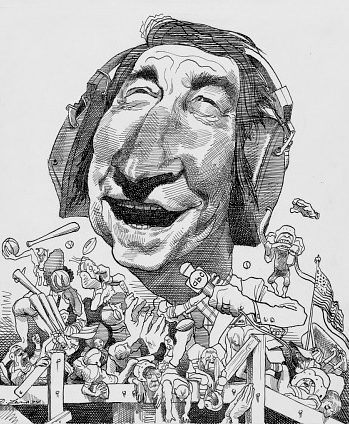
Have you ever accidentally bumped into a famous person for whom you’ve nurtured feelings of contempt? It can become a little awkward. Way back in the last century I crossed paths with Howard Cosell, …. “An audacious commentator on Channel ABC’s ‘Monday Night Football’ “…….”A most loved, most hated sports broadcaster.”……. Those are actual quotes from Britannica. Ask your Dad or Grandpa about Howard and his acidic tongue.

Looking to entertain Don, my visiting buddy, I’d mooched tickets to a Yankee Stadium suite to watch the Yanks play the Oakland Athletics. The game became so Yankee-dominated, it was boring and, as I gazed around, I spotted my surprise prey. “That’s Howard Cosell over there!” I whispered to Don who tried to feign disinterest. “I wouldn’t even turn my head,” he said.

Howard was strutting down the steps, puffing on a cigar so long, the ashes posed a threat to the fans in the lower seats. We returned to the suite later and found him pontificating from an easy chair to the young black man who’d handed us cold beers when we arrived. Now, I suddently recognized him. “Isn’t this a Giants running back you’re talking to, Howard?” I asked.

“This is the great number 30 of the New York Giants, the fleet-footed Ron Johnson,” Howard replied and I thought (“Good heavens, this guy speaks the same on and off camera! I bet when he orders breakfast it sounds like an inaugural address.”)

Guests from nearby suites drifted in and surrounded Cosell. I’m sure that’s just what he wanted, an audience. Ron Johnson posed a question: “Howard, I’ve wondered why you never worked with a black sportscaster. How come?”

“Now, Ron, you’re becoming truculent,” Cosell cautioned and I wished I’d brought my thesaurus. “You must remember I once got you a position on ABC.” Johnson was thrown for a slight loss and the others began lobbing questions at “The Acid Lungs of Channel 7.” I suddenly realized, (“They’re baiting him. What a great idea!”)

“Matt Snell was not a good football player, he was a great football player,” Howard corrected a fan. By then I was standing behind him, primed with two beers, looking down at his famous hairpiece and struggling against a powerful impulse. But I had a bigger plan.

“I remember saying to my friend, the late and great Vince Lombardi….” Howard was dropping so many big names people had to step around them to get to the john. Boxing champ Ali was referred to in lofty sentences of marble and gold, but Joe Namath had to settle for less. There were groans and even fist-shakers in the crowd. A Chicago Bears wide receiver was being dissected when my pal Don looked into my glowing eyes and said, “I think we’d better leave!”….. “Not yet,” I replied. “There’s something I want to do.”

“I can see that,” Don said. “That’s why we’d better leave!”

“You don’t understand, Don. I’m going to put down Howard Cosell when he gets to a subject I’m familiar with. Then I’ll pounce! It’s the chance of a lifetime! Sooner or later, if he’s actually a human being, he’ll have to pause to inhale. Then I’m going to say something really piercing, like, ‘Says you Cosell !’ I’ll be famous!”

“You’re out of your class, kid,” Don said, grabbing me by my collar, as he propelled me to the door, upsetting a pile of exotic adjectives that was growing in front of Howard.

As the door slammed behind us, I twisted out of Don’s grasp and shouted through the keyhole, “You’re all wrong, Cosell!” He got me in the eye with a blast of expensive cigar smoke.


RACQUET SQUAD DROP-OUT

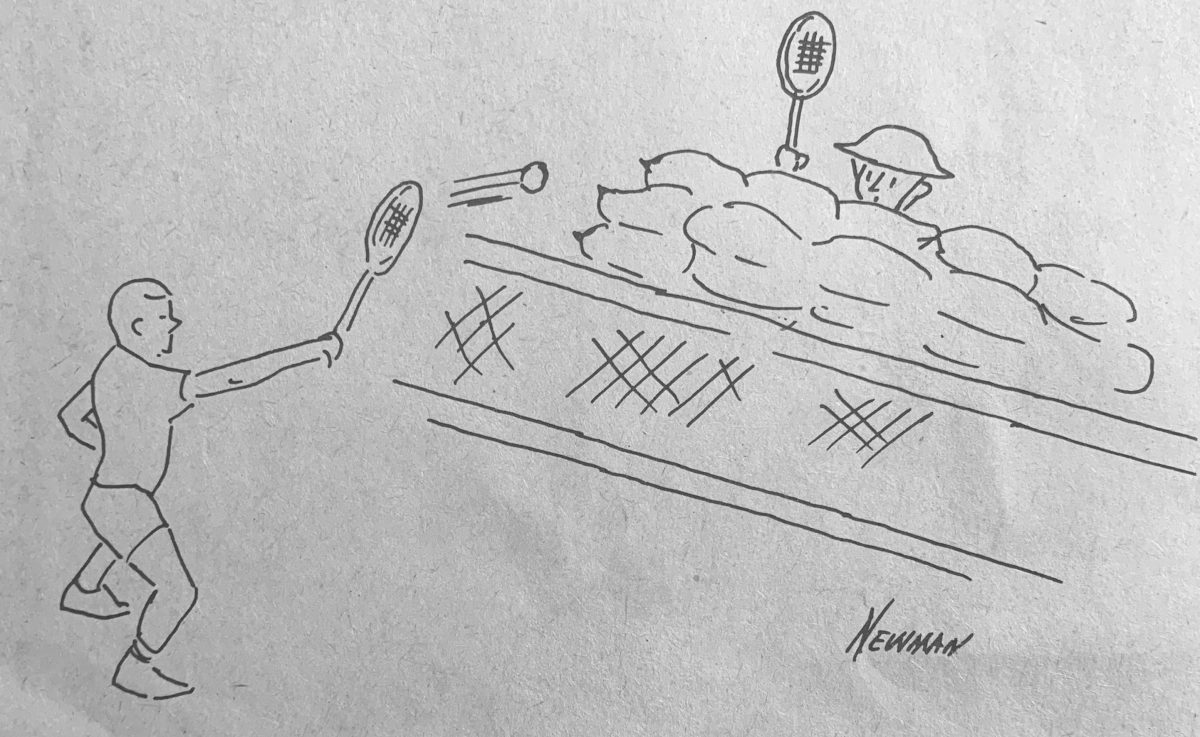
I’ve always been a follower of the popular sports fads, but I never achieved expert or even “promising amateur” status in any of them, and now I wonder why I usually stuck to it, gathering insults and injuries instead of trophies.

There were the shin splints of jogging and the surgical splints of skiiing, but the worst were the psychological wounds suffered as a stubborn tennis rookie.

Forty love again!” my opponent would shout for everyone on the other courts to hear and smirk at. There would be triumph in his voice and not a trace of pity. “Forty-humiliation!” was what he meant.

My tennis instructor had warned me against playing in singles matches. “It’s too fast a game for you right now,” he warned. But after watching me perform in a few doubles games, he was still not satisfied. “But there’s no such thing as a triples match,” I protested.

“Then how about switching to ping pong?” he said. “I don’t want any of my students physically or mentally injured. There’ll be no charge for your lessons if you’ll promise never to tell anyone I was your teacher.”

I decided to be self-taught with daily sessions of hitting the ball against a handball court wall to sharpen my eye and reflexes, playing imaginary games. I quit the day I lost 6-0, 6-2. The wall was learning faster than me.

I then began hanging out in public tennis courts until someone needed a partner or an opponent. I would step forward, faking a slight limp, hoping that might soften my opponent’s killer instinct. It never worked.

Now and then I’d manage to score a point when, reacting to a blazing serve, I’d raise my racket in self-defense and the ball would bounce off and land two or three inches on the other side of the net.

Under severe pressure I sometimes resorted to subterfuge. “OUT!” I would call with just the right mixture of authority and sympathy for my opponent. “You can’t be serious,” he’d complain. “It was decidedly out, old man,” I’d reply, and he would be sullen for the rest of the match, which usually affected his performance. The trick was, I never shouted, “Out of bounds!” What I meant was, “Out of reach!”

There came a day when I lost all hope and tossed out my expensive Wilson. (Didn’t that happen with Tom Hanks?) My wiles and my luck weren’t working. I had just been aced and imagined a wisp of smoke from my right sneaker which had been grazed by another well-aimed bullet serve. “Game, set and match!” my opponent shouted for all to hear.

“Beautiful form,” I replied, holding out a limp hand and smiling mechanically. “How about a rematch this evening? I’ve got a court reserved for nine.”

“Sorry, can’t make it. I’ve got homework to do and my Mom doesn’t let me stay out that late.”

Anyway, I always dreaded winning an important game and having to risk my neck leaping over the net. I’d already dropped out of my gymnastics class.

The Catcher in the Crabgrass

There was something magical way back then about being ten years old on a beautiful summer day, standing alone in a weed-infested right field, hearing the crack of the bat and seeing the ball arc gracefully across a clear blue sky and watching it descend, growing larger and larger while your teammates shout encouragingly, “Catch this one, Butterfingers!” And feeling the sharp pain as the ball bounced off your head. Those were the golden days!

Statistically, right field gets the least action, but I was never completely safe from concussions. I prayed more fervently there than in church. “Lord, please don’t let there be any lefties batting today. But if a southpaw comes up, please, no line drives!”

I could handle grounders, but the team didn’t like the way I ran alongside them till they slowed down. On a crucial play, I’d throw my body in front of the ball and maybe hold the hitter to a triple.

On the rare occasions when I was able to grab the bouncing ball while the runner was still rounding first, I’d haul back and heave it with all my might. I enjoyed seeing the ball fly fast and straight, usually into the grandstands . If it bounced into an adjoining ball field it usually threw that game into angry confusion.

There were no umpires for kids’ ballgames in those days. Every pitch, every foul or fair ball, every putout attempt could lead to a matter of opinions. And there were no parents in the stands urging us to accomplish the impossible.

As poorly as I played, I think I was happier than the current major leaguers who must cringe after a strikeout or a fielding error, weighed down by their enormous wealth like Dickens’ gloomy Ghost of Marley. He would have been much happier if he’d played right field instead of the stock market.

HITTING THE SLOPES…..OUCH!

Six of us clung together on the snow-covered hill, waiting for the instructor. A slight wind shift, or even a hearty sneeze would affect our delicate balance and down we’d all go again like bowling pins.

Finally, the instructor arrived, rocketing cross-hill and stopping on a dime. The resulting shower of disturbed snow sent us crashing to the ground again. “Hi, I’m Ingrid, your instructor,” she said, helping me get vertical. “Are you a beginner?” she asked.

“Not exactly,” I said. “This is my third week.”

“What can you do?”

“I can fall down to either side and I can get up. I know a dozen ways to get up now, but I’d like a few pointers from a pro about moving forward.”

“First of all,” Ingrid said, “Your ski poles are upside down. Those pointy ends can be dangerous.”

Since I was not a raw beginner, Ingrid used me to demonstrate a basic maneuver, traversing across a downhill path. “Just make it from here to that fir tree over there,” she said, and I got to that tree in quick time.

“I should have been clearer,” Ingrid apologized. “I meant for you to ski to the tree. This isn’t a crawling lesson.” I disagreed. Some of my classmates were still practicing falling down safely. Now they needed a get-out-of -the-way lesson.

After a rather disastrous “snow plow” skiing lesson, ziggzagging down the hill, dodging speedy teenagers, we arrived at the bottom thanks to Ingrid’s heroic rescues and the buddy system. We looked like a battered Mount Everest expedition, leaning on each other and on our bent poles, with our torn ski jackets flapping in the wind.

“Next is your important ski lift lesson,” Ingrid announced. (They should have ordinary elevators for beginners, I think. But no, they have only confusing uphill lifts and ambulances.)

“The lift chair is your comfortable carrier to the top,” Ingrid announced. “Just move quickly as the chair arrives, slip in and enjoy the ride.” A moment later, she was shouting, “STOP THE LIFT!”

I tried to be of some help in untangling the pile, but I was near the bottom and somone’s ski had me pinned down.

Ingrid looked in at the First Aid Station where some of us were being patched up. “You’re a courageous skier,” she said to me, but I’m sure you should try some other sport.”

“I agree, Ingrid,” I said. “But skiing was at the top of my bucket list. I guess I’ll just try my second wish where there’s only one simple step to take.”

“What’s next on your list?”

“Sky diving.”

“Oh dear!”


Operation Oscar

A long time ago I overheard a very interesting conversation on a New York bound bus as we passed through the Meadowlands. I was a reporter then and began to take mental notes.

“Remember Oscar?” one fellow asked his seat mate.

“Oh sure, good old Oscar from our lodge. Whatever happened to him?”

“He’s back there in Giants Stadium. That’s what reminded me.”

“Old Oscar? What is he, an usher, a groundskeeper?”

“Oh, you didn’t hear. Oscar died last January. It’s an interesting story,” the first man said. “He was watching a Giants home game on the lodge’s TV one Sunday when he mentioned to the other guys he’d like to eventually have his ashes scattered over Giants Stadium.

“His pals remembered this and after Oscar died and was cremated, they told his widow about his wish and the grieving lady gave them his urn. One dark night they made a quick pass over the stadium in a hired plane and, ‘Oscar’s away!’ “

As a reporter I had so many questions to ask about Oscar’s life and launching, but I didn’t think the story-teller would cooperate, especially since Operation Oscar must have broken more than one law and would get the pilot and crew of that little plane in big trouble.

First of all, if Oscar was such a devoted Giants fan why was he watching that home game on TV instead of sitting inside the nearby stadium with his season ticket? But maybe I got the wrong slant. Maybe Oscar was a disenchanted fan, worn down by the frustrations of too many losing seasons. Maybe he didn’t want his ashes scattered in the stadium, but thrown at the team.

Another thing, was the Oscar-dusting mission planned carefully? How does one plot the trajectory of ashes? Is Oscar really in Giants Stadium or did an errant wind doom him to eternity is some Secaucus backyard?

Assuming there were no unforseen errors and Oscar landed on the 50-yard line, then what? Giant Stadium back then had Astroturf and Oscar would never be able to assimilate. He would have been blown hither and yon by the winds and into the eyes and on the cleats of all the players. Eventually he’d be inside all the stadiums of the NFL. Was that his plan?

I’ve grown to like Oscar, an impulsive romantic. If I ever go to a Giants game I’ll pay him homage. Before I sit down, I’ll brush off my seat with due reverence. You never can tell.


Landmarks

Someone once cut down a tree on Kinderkermack Road in Bergen County and caused me to wander aimlessly through back streets for over an hour. For several years that big evergreen had been my landmark turning point on my way to my daughter’s house.

That was long before GPS when many of us were landmark travelers. In fact, that day when I finally turned into my daughter’s driveway, three following cars stopped at the curb and three old drivers glared at me. I guess they’d also been confused by the tree removal and hoped I might be headed for the Parkway.

We landmark drivers would have been okay if they’d replaced that giant tree with something distinctive like a fire house or a gas station but certainly not another QuickChek which were proliferating back then. I could end up in Philadelphia turning at the wrong QuickCheks.

Map Quest wasn’t much help then either in getting to my daughter’s. When I read “Turn left onto Duffy Street and drive 2.6 miles to Hubschman Avenue,” I’d have my eyes off the road too long reading the odometer and the street signs. An unmistakable visible landmark would be safer. McGinty’s Tavern happens to be on the corner of Duffy and Hubschman, so why not use that as a landmark for the turn? McGinty’s big neon sign would be visible for a half mile.

I have one other navigational tactic for places with no road signs and no roads either. I once discovered a great spot for catching large mouth bass on Lake Hopatcong. It was about a stone’s throw from the east shore. (A young boy on the east shore was throwing stones at me and falling short.)

But how far northeast was I from the boat rental dock? Problem solved. Right after I raised the anchor I began singing “Danny Boy” and rowed southwestward to the dock singing all the way.

If you want to catch those magnificent bass, get a rowboat at the rental place and, keeping one stone’s throw from shore, head northeast singing all four choruses of “Danny Boy”. Then drop your baited hook and expect a fight.

If that’s too confusing, I’d be willing to give more precise directions. You can buy me a beer at McGinty’s. I’m there most Saturday nights.

CELL MATES

When the cell phone tidal wave hit, at first I swam against the current but eventually my wife convinced me to join the flow and I convinced her the whole idea needed a little tweaking.

Trapped in a morning traffic jam driving home from the ShopRite, I, the retired guy, tried to look like one of the angry stalled commuters who were cellphoning their reports of unavoidable delay and also giving me dirty looks for being part of the jam.

Reaching into one of my grocery bags, I pulled out a can of sardines, and shouted “I’ll be late for the executive board meeting.” The sardines had no comment, but the very old guy in the next car seemed to have the same idea and was haranguing a subordinate through a can of beans. I wished I could read lips.

I also wished then, that I could be as adaptable as my wife. “Think of the cell phone’s value in reporting an emergency, ” she argued. “You can immediately contact the EMT’s”

She was right of course. I had no real rebuttal, but I tried anyway, “What about a flare gun parachute to add longevity and altitude to a plea for help?”

“But sweetheart, ” she countered, “Think of the minor nuisance of a cellphone ringing in a crowded theater against a parachute flare accidentally ignited in the balcony.”

“Okay, dear, you win. Flare guns are out for indoor emergencies, but there’s another big problem with cell phones that bothers me.

“With so many carrying cell phones in pockets and purses, telephone booths have almost disappeared. They should require booths be installed in stores, malls and other public buildings and insist cellphoners step inside to make and receive calls without disturbing everyone else with their conversations, the way it was in the good old telephone booth days.”

“I agree with you, Dear,” my wife said. “Why should patients in a waiting room have to get involved with someone’s picayune problems when they’re awaiting their X-ray results”?

“If they’ll solve that one, it’ll also get rid of the other , the Clark Kent one that bothers me,” I said.

“The Clark Kent problem?”

“Yes. Clark lost all his convenient Superman changing booths. If the idea of required indoor cellphone booths catches on, he’ll be able to switch privately again. “

First Picnic

It was our very first picnic date and I was quite nervous. Barbara was the lifetime girl for me and there were hopeful signs the feeling was mutual. So this was an important day, sandwich-wise.

I was willing, if she’d eventually say “yes”, to eat baloney or packaged olive loaf sandwiches on stale white bread for the next 30 years if necessary, but “otherwise” would be even better.

I was a young engineer and tended to think mathematically. I figured, with a mid-echelon career, I’d be eating almost 8,000 sandwiches for lunch at my desk before retirement.

I tensed up as Barbara opened the big wicker basket, reached in and began unwrapping a package. “Pumpernickel !” I shouted, stifling a giggle.

“Yes, and I hope you like braunschweiger,” Barbara said. “Some people don’t, but with Dijon mustard….”

“Isn’t that (sniff, sniff) a dill pickle?” I interrupted.

“Straight out of the barrel,” Barbara replied. “Is that the kind of sandwich you like? You did mention once you’re very particular about sandwiches.”

“Barbmmmlvlovmmyouwimy!” I replied through a mouthful of a magnificent delicatessancy. I swallowed, apologized and said, “I’ve loved you with all my heart and now I love you even more!”

We lived (and lunched) happily ever after.

PANICKY POSIES

Do your daffodils seem despondent? Have your roses become remote? Are your forget-me-nots acting fretful about something they’d rather not remember?

We’re learning more now about the living, breathing, emotional inhabitants of our gardens, farmlands and forests. They’re not always completely happy while providing us with food, medicine, lumber and fresh air. Believe it or not, even lacking brains, they can experience personal anxiety.

For instance, scientists report tests that prove some edible plants will collapse their leaves when they are touched by humans, perhaps to discourage hungry vegans. Polygraph (lie detector) tests have confirmed these emotional reactions of plants when handled roughly.

On a less professional level, two groups of school children tested the reactions of plants subjected to praise and disapproval. One group complimented a plant every day for a month, while an identical plant was insulted daily by a second group. At the end of the month, the praised plant had grown in size and improved in appearance while the insulted plant’s leaves had turned brown. Let’s hope the second group of kids felt bad enough to tell their wilted plant, “We’re sorry, Pansy, we didn’t mean a word of it.”

Without employing any scientific procedures I’ve become convinced over the years about the unstable emotional condition of the plant life in my backyard. There’s my neurotic lawn which, in spite of my tender care and encouraging words, becomes suicidal around July 15th every year. There is such a thing as “Panic Grass”. You could look it up.

I have a sneaking suspicion my lawn is somehow agriculturally related to and somehow, emotionally connected to the New York Mets infield. July is often a bad month for that beloved team. I’ll bet the groundskeepers’ troubles increase during every slump.

Some people claim they are more in tune with the feelings of plants than the rest of us. My brother-in-law merely glanced into my vegetable garden one day and exclaimed, “Those are the saddest tomatoes I’ve ever seen!” He left with a large bag of “morose” big Burpees, so I suspect his diagnosis.

I planted an oak tree sapling over ten years ago assuming it would become the typical giant of the forest, a legacy for my grandchildren. But it’s still much shorter than me. A local nurseryman could not give a reason for the lack of elevation, but I think I’ve figured it out. Acrophobia! My oak tree has a fear of heights. I might have to build a 25-foot trellis.